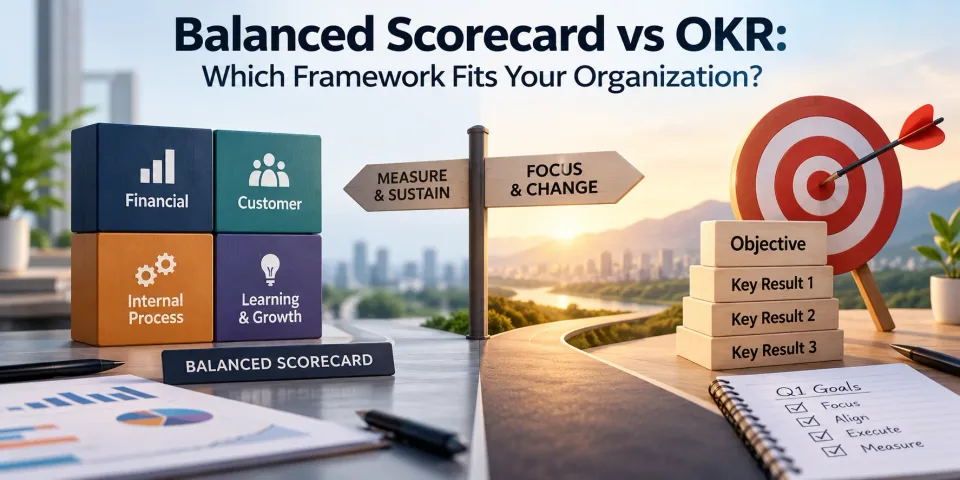
The short answer
Use the Balanced Scorecard to decide what your business must keep measuring; use OKRs to decide what must change this quarter. They answer different questions, which is why a head-to-head comparison often leads mid-size firms to pick the wrong one.
A 300-person manufacturer with steady orders but no shared view of customer or process health needs a scorecard first. A 150-person services firm with a strategy on paper, but teams that work on whatever is loudest, needs OKRs first. The rest of this article helps you tell which firm you are, and how to combine the two when you are ready.
Each framework in one minute
Balanced Scorecard (BSC). Robert Kaplan and David Norton introduced it in Harvard Business Review in 1992, as a response to firms that managed almost entirely by financial results. It views the business through four lenses: Financial, Customer, Internal Process, and Learning & Growth. Each lens carries a few objectives, measures, targets and initiatives, reviewed monthly or quarterly. It changes slowly, because it describes the health of the whole business.
OKR (Objectives and Key Results). Andy Grove developed the approach at Intel in the 1970s, and John Doerr, an Intel alumnus, brought it to Google in 1999. An Objective is a qualitative, motivating outcome; three to five Key Results are the measurable signals that it has been achieved. Cycles are usually quarterly with weekly check-ins, and targets are meant to stretch. It changes every cycle, because it describes what the team is trying to move right now.
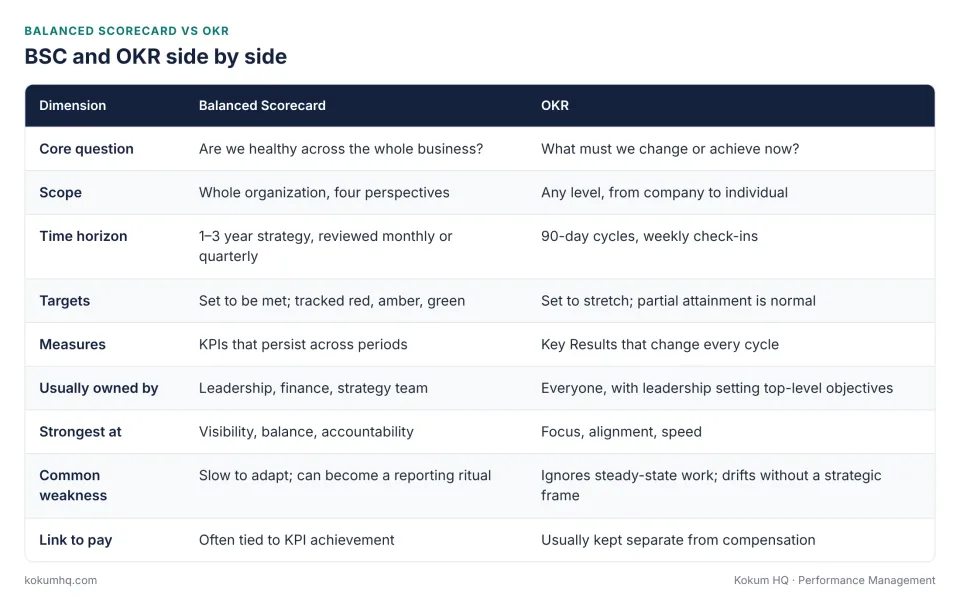
BSC and OKR side by side
The two frameworks differ most in the question they answer and the speed at which they move.
Which fits at which stage of maturity
Organizational maturity decides where to start: firms with little structure gain most from OKRs, while firms with plenty of data but little direction gain most from a scorecard.
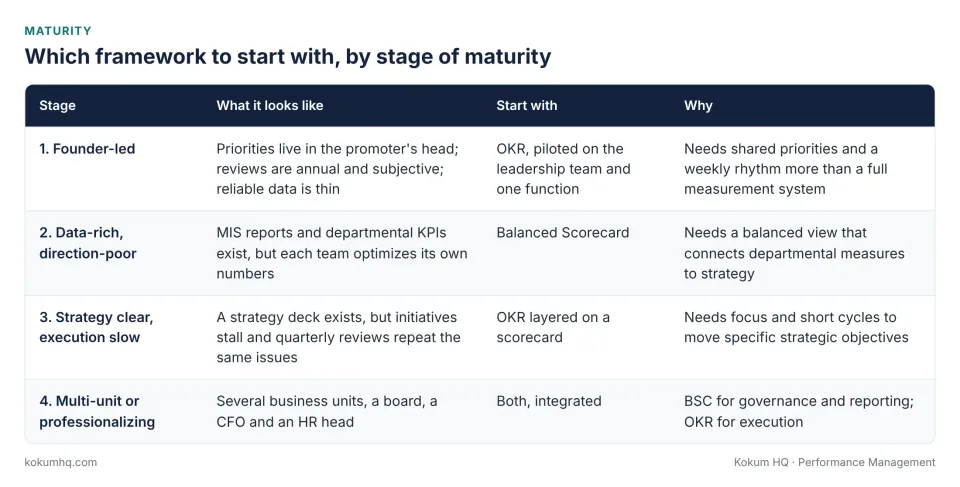
These are tendencies, not rules. A firm can sit between two stages, and the questions later in this article help you place it.
Strategic context matters as much as maturity
In a stable market the main risk is drift, and in a shifting market it is slow response. The scorecard guards against the first, and OKRs guard against the second.
Lean toward a Balanced Scorecard when:
Your market is stable and the business runs on repeatable processes, as in contract manufacturing, distribution or regulated services
Lenders, boards or promoters want the same view every quarter
Short-term numbers are crowding out customer, process or people health
Several departments need a common definition of success
Lean toward OKRs when:
You are launching a product, entering a new geography or turning around a unit
Strategy is clear but execution keeps slipping
Teams work in silos and need to see how their work connects
You want to re-aim every quarter instead of every year
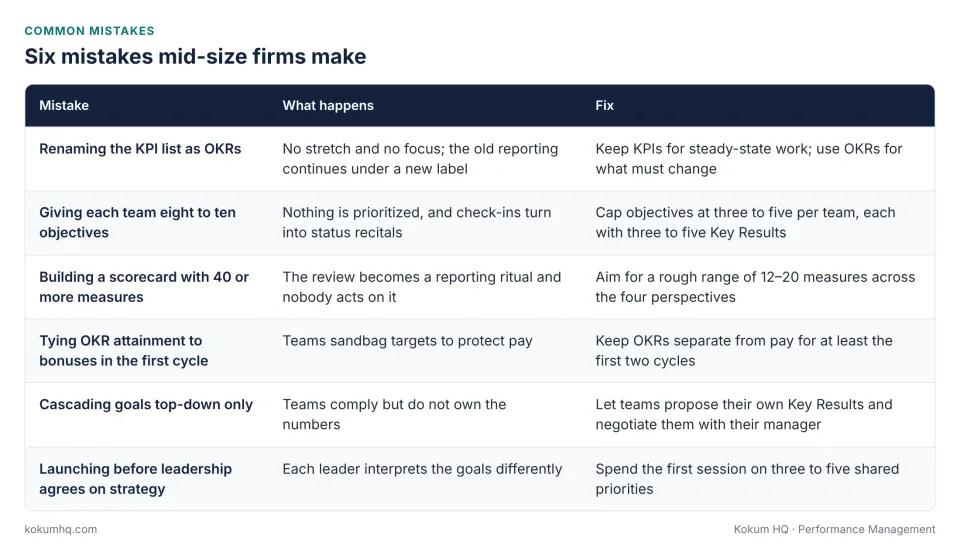
Six mistakes mid-size firms make with each framework
Most failures come from using one framework to do the other's job
How to combine them: the scorecard is the map, OKRs are the engine
The cleanest combination uses the scorecard to show where the business is weak, and each quarter's OKRs to fix those areas. Measures that are green need no OKR this quarter, which keeps the number of objectives small.
The example below is illustrative, for a 250-person industrial services firm.
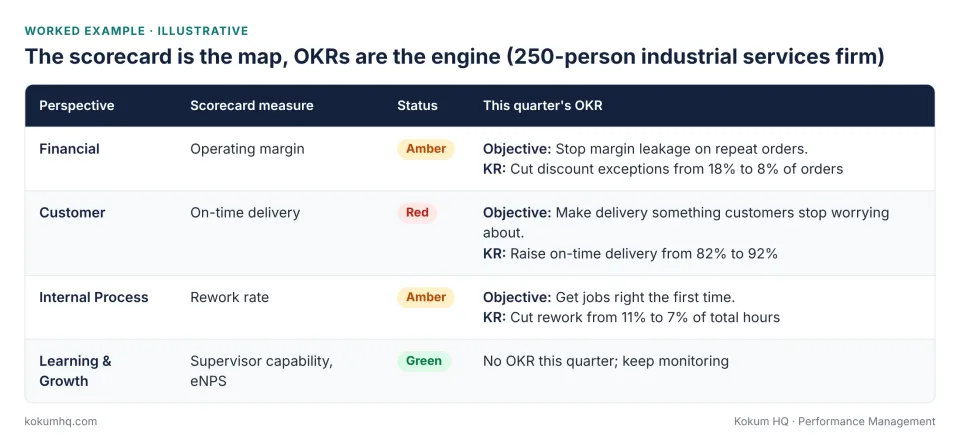
The working loop has five steps:
Review the scorecard at the start of the quarter and mark each measure red, amber or green.
Write company OKRs only for the red and amber priorities.
Cascade to teams, letting each team propose its own Key Results.
Run weekly OKR check-ins and a monthly scorecard review.
Grade the OKRs at quarter end, refresh the scorecard, and set the next cycle.
A six-question decision guide
Answer these six questions honestly with your leadership team, then count where each "yes" points.
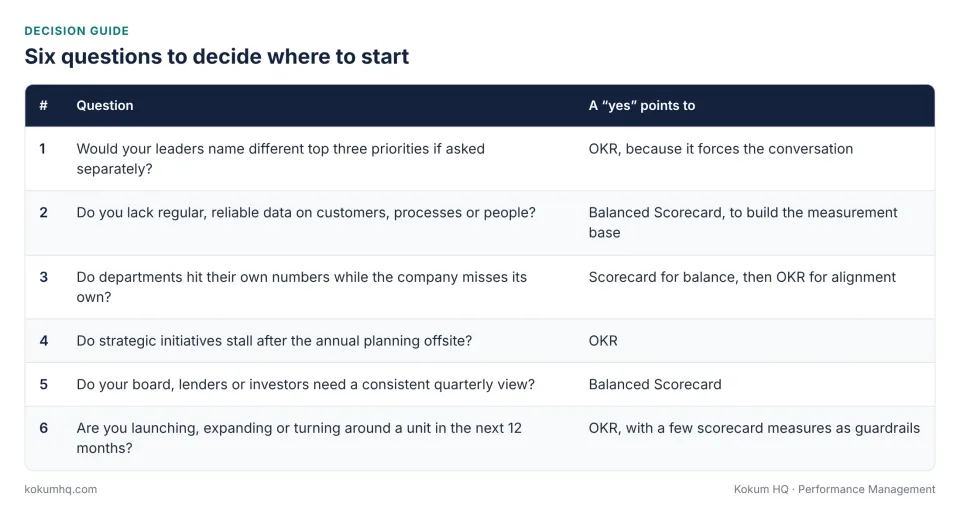
Mostly OKR answers: start with OKRs and add a scorecard within two or three cycles. Mostly scorecard answers: build the scorecard first, then add OKRs for the red and amber areas. A mixed result means you are ready for both, in the sequence below.
A 90-day sequence to get both working
A firm can get both frameworks running in one quarter if it sequences the work and resists the urge to build everything at once.
Days 1–15: Agree the priorities. Run one leadership session to settle three to five strategic priorities, and draft a one-page scorecard with two or three measures per perspective.
Days 16–30: Baseline the scorecard. Pull current data for each measure, mark it red, amber or green, and accept that some baselines will be rough.
Days 31–45: Write the first OKRs. Set company OKRs for the red and amber priorities only, then let each team draft its own Key Results.
Days 46–90: Run the rhythm. Hold weekly check-ins, a monthly scorecard review, and a short retrospective at day 90 to grade OKRs and set the next cycle.
Expect the first cycle to be imperfect. The aim is a repeatable rhythm, and the quality of objectives improves with each cycle.
Choose by fit, then combine
Choose your starting framework by your firm's maturity and the pace of your market, not by which one is more popular. The scorecard gives you a balanced view of the business, OKRs give you focus and momentum, and most growing firms eventually need both.
If you would like help deciding where your firm stands, you can book a free 30-minute consultation. The Performance Management hub also has a Balanced Scorecard Design Worksheet and an OKR Implementation Template to get you started. Kokum HQ's OKR software supports goal cascading from CEO to individual, weekly check-in workflows and progress dashboards, with Balanced Scorecard integration available.